Throwing Fruit at the Elderly

Ben had an ear stud

And was already thirteen,

Which made him the natural leader.

He marched us across the wasteland

In a proper wedge formation,

Scraggled grass and dust

At our feet.

When we reached the chain-link trees

And leafed fence, sun in our

Eyes, he pointed out the old persons’ home.

Pruned Glaswegians lay sunk

In the terrace deck chairs.

We had munitions:

Wild fruits like cranberries,

But poisoned, maybe,

And we flung them with our kiddy arms.

Until Ben cried,

I got one in his mouth!

We bolted then, but a rasp from the faded

Feminine span me round.

Let me get a good look at ye,

Ye delinquent thug!

My conscience whimpered, and I hated Ben.

Getting Away With Things

People get away with things

Because they make good metaphors.

Nobody wants squid ink in their cow’s milk,

Or snake bite in the community well;

The path most trodden is for chattel,

With the cud unchewed

In all four stomachs.

And the voice on the corner,

Swept up in the prevailing wind,

Surely has some sense to breathe

From her unkempt lips.


Don’t you hate it, when the umbrella

Span is nearly enough and leaves you nearly wet?

You pull it down fast, like a blind,

And single hairs get yanked in the metal hinges.

The amount of human festooned

In umbrella frames defies belief.

Plenty to restart, when we realise

The personalised clods we stand on

Owe us nothing.

That’s assuming, of course, that Elon

Finds enough introvert fuck-ups

To water carrots for the rest of their lives.

People get away with all sorts of silly things.

Some Thoughts on Donnie Darko

Gretchen Ross traipses through the empty halls of her new school. Class has already started, and now she’s going to embarrass herself by interrupting. She pulls her textbooks more tightly to her chest. Here it is: room 28. She enters without knocking. The hinge creaks like an arthritic wardrobe. She may as well have announced her arrival with a trumpet.

Sixteen heads swivel round to gawk at the newcomer. Slouched against a desk at the front, facing Gretchen, is Drew Barrymore.

“May we help you?” she enquires.

“Yeah — I just registered, and they put me in the wrong English class.”

“You look like you belong here.”

Gretchen isn’t quite sure what to make of this comment. “Um. Where do I sit?”

Drew Barrymore considers for a moment, her mouth turned downwards in mischievous contemplation. “Sit next to the boy you think is the cutest.”

It was at this moment, whilst watching (almost two decades late) Richard Kelly’s cult classic, Donnie Darko, that I began to feel like I was viewing the most realistic representation of a dream ever recorded. Drew Barrymore’s suggestion is so deliciously prurient, so un-teacherly, that in the mouth of a bad actor it might sound forced or clunky. But Barrymore carries the line, establishing herself as something of a free-spirit within an otherwise crusty institution. I never once questioned the propriety of her words. Nor did I question an obvious plot hole that crops up moments later: Barrymore allowing Gretchen to sit next to Donnie, whom she appears to have chosen as the “cutest”, by making another girl stand up. It’s never explained where this displaced student is moved too, as there don’t appear to be any free seats in the class. But all of that is besides the point. Just as in a dream, your focus is on an immediate, seemingly-logical narrative; one that, in the analytical light of morning, was clearly an illusion, riven with impossibilities.

Donnie Darko is chock-a-block with such vivid, oneiric moments. For instance, we’re soon introduced to Barrymore’s foil in the film, a vindictive, super-Christian teacher/parent named Kitty (think Angela from The Office). In one of the film’s best scenes, Kitty (wearing a “God is AWESOME” tee) calls on Donnie’s mother and, standing in her doorway, begs her to accompany the student dance troupe to Los Angeles the next morning, as she’s no longer able to take them herself. As Mrs. Darko demurs, Kitty becomes frantic. Eerie, wailing music creeps into the exchange — music that belongs in a confined space, as an overture to some terrifying revelation. And yet here it is, in the sun-dappled streets of Middlesex, Virginia. Kitty’s consternation mounts. With the cracked rasp of a penitent murderer admitting to their crime, she speaks the damning words, “Sometimes I doubt your commitment to Sparkle Motion!” (Understandably, this line has become a fan favourite; you’ll find it oft repeated in the comments section of any Darko-related material online). Mrs. Darko’s response is equally loaded. She doesn’t speak, she simply stares at Kitty with a tortured smile, as if to say, Have you ever stopped to listen to the bullshit you’re spouting?

Indeed, my main takeaway from Donnie Darko is its insistence on the need to cut through bullshit: to separate the false logic of dreams from tangible reality. To speak out against things that don’t make sense. We see this most clearly in Donnie’s “Life Skills” class, taught by none other than Kitty. In one segment, the class are made to watch a video on overcoming fear, presented by local life coach Jim Cunningham (Patrick Swayze). Richard Kelly deftly condenses every awful, cringeworthy educational video of your youth into an absurdly saccharine two minutes. With clichéd spiritual rock riffing in the background, a woman stares down at her son, lamenting, “For two years, I thought it was normal for a ten-year-old to wet the bed.” This elicits a single, quickly-hushed snigger, but most of the class watch without expression. They’ve become so accustomed to this moronic, feel-good propaganda, that they can’t even find it funny. We then get a portrait shot of the bed-wetter, who exclaims, fiercely, “I’m not afraid anymore!”

The video serves to foreshadow Donnie’s stand in a later lesson. He refuses to accept Cunningham’s philosophy (espoused by Kitty) that all human action can be divided into two emotional causes: fear and love. He challenges Kitty’s restrictive thinking, arguing on behalf of “the whole spectrum of human emotion”. Yet in the twisted dream-logic of Donnie’s world, his reliance on common sense is not met with any kind of rational debate. Instead, Kitty threatens him with a zero in his assignment. Encapsulated in this exchange is the idea that life — especially an institutionalised life — can sometimes feel more like a dream than reality. The rigorous prescriptivism of exam-centric schooling ensures that students are ushered along from one year to the next, never challenging what they are taught, never deviating from the syllabus. In this way, the film implies, school is made of the stuff of dreams: bullshit.

I realise now that I’ve said quite a lot about Donnie Darko, without even mentioning its more obviously surreal elements. For instance, early on we’re introduced to a prophetic, man-sized rabbit named Frank. Soon after, Donnie starts to observe temporal portals sprouting from people’s sternums. The issue is that Donnie’s perspective is less than reliable. He’s taking medication for schizophrenia, and is a self-confessed “whacko”. People have spent an awful lot of time and energy theorising on these aspects of the film. How real they are, what they mean, why exactly Donnie has to follow Frank’s orders to prevent an impending apocalypse. To my mind, though, these more fantastical aspects of the film are equivalent to a dream’s underlying emergency. Take, for example, the common dream-emergency of being late for an exam — one that I experienced a few times before Finals. I don’t recall ever actually making it to Exam Schools to face the consequences of my tardiness. Instead, I’d find myself waylaid by random figures from my life, people who had no business being on the Oxford High Street at 9.30am. If I’d simply stopped to consider the implausibility of their presence, the dream-logic would have crumbled. Similarly, the closer Donnie draws to Frank and the film’s mysticism, the more “reality” starts to unwind. When Frank convinces him to burn down Cunningham’s home, the celebrated life coach is exposed as a paedophile; as Donnie prepares to confront Grandma Death, Gretchen reveals her mother had been abducted. The accepted truths of Donnie’s world — our world — seem increasingly ephemeral. The best in society are fraudsters, and nobody is ever truly safe. It’s hardly surprising, then, that Donnie turns his back on this “reality”. He decides rather to go straight down the rabbit-hole, to avert the dream-emergency and awaken himself from a living sleep.

Some Thoughts on Rupi Kaur’s Most Recent Poem

I’ll start this piece with a disclaimer: I think Rupi Kaur is an awful poet. Her cutesy, axiomatic style is almost entirely lacking in the mystery, invention, and force of language that, for me at least, make a great poem. That she’s achieved such global fame (mainly through her Instagram presence) pays testament to our sorry habit of revering mediocrity, so long as it is easily digestible.

I’ve yet to meet anyone who will earnestly defend the quality of Kaur’s writing. However, I have heard two arguments in support of her work more generally. The first is that Kaur often acts as an introduction to poetry for young people. This argument characterises Kaur as a gateway poet, in the same way that a Good Christian Mum might characterise weed as the initial step towards a life of crack-fuelled hedonism. And, I’m sure, some people have gone on to read more challenging and creative material since discovering Kaur. Yet I worry that the simplicity of Kaur’s work, its unabashed lack of intrigue, makes people less receptive to such complexity in other poems. For someone on Instagram, it’s far more likely that their following of Kaur will lead them to discover accounts like Atticus, whose on-the-nose sententiousness makes Kaur’s poetry look like an enigma code.

The other argument, which, in my opinion, carries more weight, is that Rupi Kaur is not so much about the medium as the message. That most people who follow her know very well that they aren’t reading innovative verse, but support her central ideas of feminist empowerment. And I can absolutely get behind that. Indeed, I imagine Kaur herself is well aware that it is her message, rather than her art, that does the numbers (I mentioned at the start that I think Kaur is an awful poet; I also think that’s she’s an astute entrepreneur).

However, Kaur’s reliance on a fundamental idea, as opposed to good writing, comes with its own drawbacks. As an example, we need only look at her most recently uploaded poem:

The first thing I noticed about this poem was its form: a single block of text. For Rupi “hit-the-enter-key-at-irregular-intervals” Kaur, this is practically radical experimentalism. But the next glaring aspect of this piece is its rather ugly tone. Kaur predicts that the addressee’s next girlfriend “will be a bootleg version of who i am.” (Side note: Kaur appears to have an inexplicable aversion to capital letters). We might wonder why Kaur, who’s brand is built around supporting women, inspiring women, and articulating women’s issues, has decided to go after a woman who she’s never even met. Worse, she then goes on to discredit this future woman’s poetic and sexual proficiencies: she won’t “lick, caress, or suck” like Kaur, and her poems certainly won’t be delivering any jabs to the gut — she’ll only “try to make love to your body” (spoken to the rhythm of Shape of You by Ed Sheeran).

The main thrust of the poem is clear: Kaur is engaging in a common post-break-up fantasy, imagining her former lover’s dissatisfaction with his new flame. The “bootleg woman”, caught between Kaur and the target of her angst, is ground into inferiority by Kaur’s exultant vision of a pining ex-boyfriend.

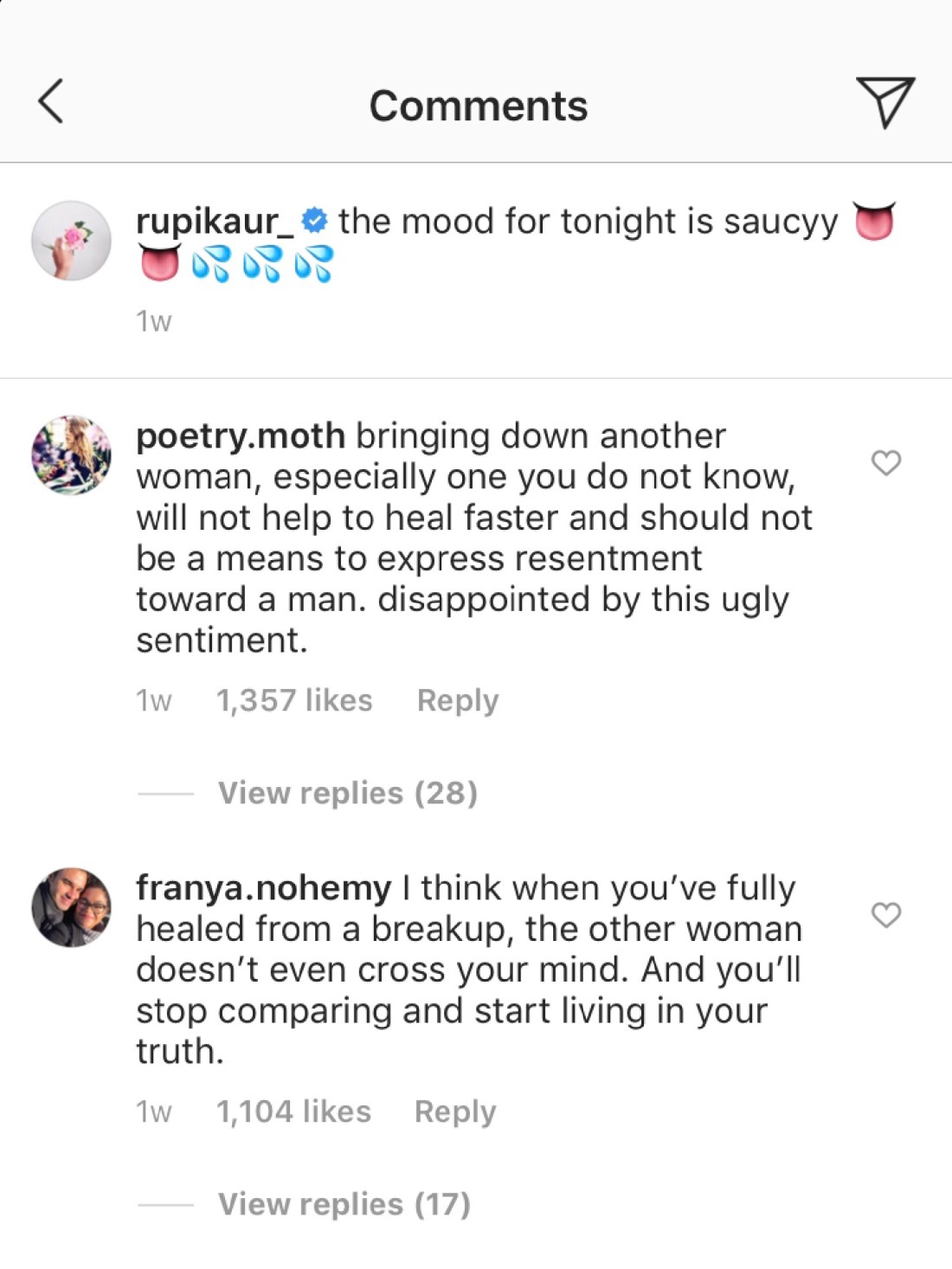
Significantly, Kaur might have cleared all of this up with a simple addendum. She might, for instance, have mentioned that this poem is a representation of internalised misogyny. She might have mentioned that the behaviour of men in relationships can create feelings of conflict amongst women (and that often, these feelings are misdirected). Instead, all we get is the caption: the mood for tonight is saucyy, along with a few emojis that, to be fair, neatly illustrate the line “lick, caress, or suck like me”. (Another side note: I shudder every time I write that out). These words make it clear that Kaur doesn’t recognise the troubling suggestion expressed in the poem. Namely, that being a woman on top sometimes involves putting other women down .

Maybe I’m being too harsh. Maybe I need to remember the first rule of poetry analysis, and separate Kaur from the speaker of the poem. Ordinarily, I’d agree. But in this instance, I find it almost impossible. You see, Kaur spends a lot of time making her poems as generic — and therefore as relatable — as possible. She’ll often crank out a variation of the following:

my body is a [natural phenomenon]

you may try to [something to do with curbing nature]

but I will [something to do with escaping confines].

These poems achieve mass-appeal because there is so little of Kaur in them. They can be taken up by readers, and applied to their lives. They’re similar to pop songs, in that their catchiness lies in their lack of specificity. Yet Kaur’s most recent offering is different. In particular, the mention of poems that have been “left memorized” on the ex-boyfriend’s lips make it abundantly clear that Kaur is versifying here as herself.

Moreover, the clichéd mundanity of the poem, the absence of arresting imagery, ambiguous phrasing or novel tone, ensure that there is scant material to hold on to other than the central idea. Kaur’s business model, of maxim-like poetry designed to impart a simple message during a quick scroll, makes it difficult to read these more specific poems as anything other than her own direct thoughts. Consequently, when Kaur diverts from her usual ideas, of obvious feminist-empowerment or twee reflections on the sun/moon/flowers/butterflies/et cetera, people don’t criticise the quality of the poem, but rather the quality of the message (although about 90% just type yaaaas kweeen 💅🏼, probably without reading a word):
I suppose then that Kaur has created her own poetic prison. Having established herself as the voice of feminist poetry on Instagram, and having built an enormous following through deliberately generic verse, her attempts to move towards more personal or specific ideas are likely to meet backlash. She doesn’t have aesthetic creativity to fall back on. All she has is a central idea. And reliance on a single idea encourages stagnation — the death of poetry.

Adrift I.

Fourteen days adrift at sea.

Morale had ebbed as far.

Sun dried spittle on the lips

Which crimped like roads to Shangri-La.


Men sucked orange (flesh and pips)

And ground the rinds down for their tea:

“A treat,” they’d whisper, close to tears;

The waves below lapped hungrily.


More days passed, in their place fears

Took sailors in their grips;

Those fears hauled three men overboard

To glug a fate beyond their ship’s.


At length one sailor saw his sword

Not as a sword but as some shears

With which to trim a better meal than

Dregs and rinds and empty beers.


Man looked to man much less like man,

Much more a scrumptious hoard:

Offal, marrow, suckled meats —

Enough for fillets flat and broad.

Hayfever

June rolls around, and I hear them,

Coiling their canisters

In the meadows 

And depressions 

Left by picnic blankets.

They want to bung me up,

To pepper-spray me until

My eye-water leaves me

Smudged rugged.

They want me to slow choke,

And wake with a stale fur

Like lichen over

Teeth and tongue.


These are your flowers, you poets,

These Husseinist bioarms,

These roses and lilies,

Petunias and daffodils,

Ranked to smear summer

Across the unchallenged face.

A Better Name

What do you know?

My name.

Your name?

My name.

Do you suppose Eric

Is stamped on your soul

In indelible hand?

Or did Dickie and Sue

Pluck randomly from

A blue boys’ book of names?

The latter.

Is Eric then the germ

Of each thought, word and act

That Eric — yourself — enacts?

Unlikely.

Unlikely.

Maybe though I have a better name?

One that spoken explains my borders

And maps out my life to the last.

Without a doubt.

But tracing that name is like damming 

Time’s meander:

Hopeless, hopeless,

But what else can you do?

YOOOOUUUU…


Excuse Soulja Boy,

He’s here every morning —

Here for the same reason as you,

Would you believe it?

Shrink wrapped voice:

Nice squeaky cling-film

Round the larynx.

A few escapee YOUS!

And CRANKS! 

Maybe even an OH! 

Very little past that.

But why are you so hushed?

Who’s netted your tongue,

Loosened your cords?

You don’t want to end up 

Like him, do you?

No, I thought not.

So say Aaaaaaah,

And let’s see what we can do.

Nervosa

I.


An–, GREEK: without.

Orexis, GREEK: appetite.

It’s true enough.

I lost my hunger for just about everything:

Love, fun, people.

I hungered only for hunger,

And hunger meant control.


I probably would have dragged

My unfed muscles

Across a mile of

Shattered willow pattern crockery,

Just to hit a calorie deficit.


And what do we see,

Depicted in said fragments?

A father’s consternation, blue.

A sister’s muted concern, white.

Friends smashed, morals smashed,

My feet blooded, a celery heart in each hand.


II.


Writing on the topic proves challenging.

Not emotionally — I’m a certified sharer —

But pragmatically.


My brain’s changed;

I find it hard now to pull on that old suit —

It’s a tight fit.

The Master-Poet

Oh, tell us!

Won’t you tell us?


The master-poet smiled.

The smile meant no.


He adjourned to the coast to die.

From a clifftop verandah he peered down

At the swash, hoping for a glimpse of Venus,

Birthing on the waves.

He didn’t see her,

And so he lay down to die.


Crowds bubbled to hear The Simile:

Students, professors, aficionados, 

Past lovers, fellow poets,

Those who knew the master-poet

As a sardonic cad.


Ahem.


I’m like the tooth fairy,

In that I’m secretly your Dad.