

The most exciting person in US politics wasn’t on the debate stage last night. And we need some of his thinking across the pond too.
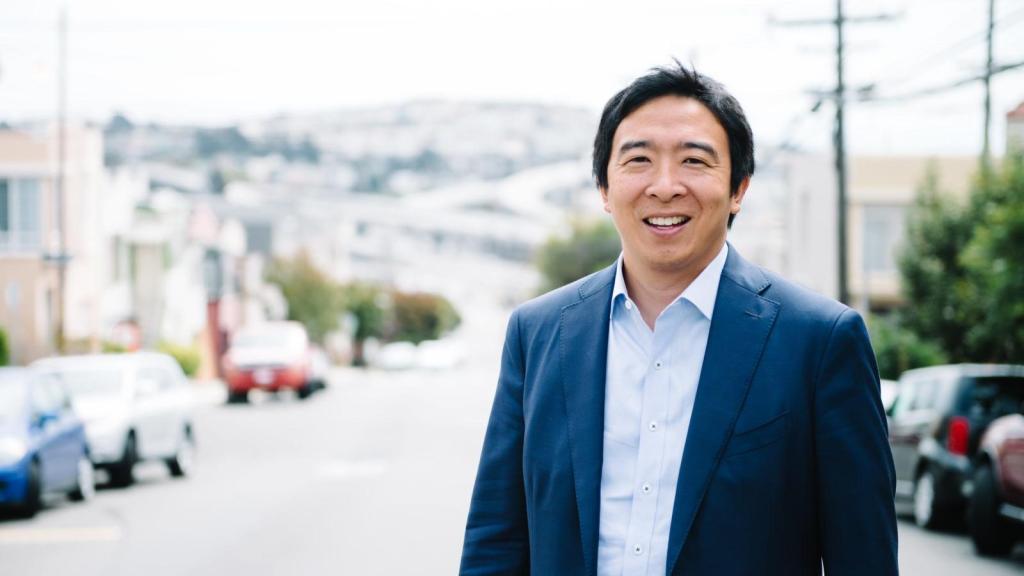
Amidst all the mud-slinging and acid-spouting of America’s current election cycle, one candidate stood out as uniquely removed from party politics — someone who advocated for long-term solutions to the country’s problems. That figure was Andrew Yang. And though he was beaten out of the Democratic primaries by Biden, he’s helped bring Universal Basic Income (UBI) into mainstream conversation, to the point where it’s found support in prominent figures like Barack Obama, Jack Dorsey and Elon Musk.
Yang’s basic premise is that all American citizens aged over 18 would receive $1,000 dollars per month, no questions asked. UBI would replace the majority of welfare payments (except in cases where UBI would amount to less than an individual’s pre-existing payments). The scheme would be paid for through novel taxations, such as a carbon tax and fairer taxation on Big Tech.
Since dropping out of the election, Yang has continued his dissemination of progressive economics, both through his weekly podcast (Yang Speaks), and his philanthropic venture, Humanity Forward. The latter acts as a kind of UBI in miniature, delivering regular cash payments to households in need. Yang, clearly, is a person prepared to put radical theory into radical practice.
As I’ve listened to Yang, I’ve grown to feel that the UK political scene is in dire need of a similar character: a data-driven idealist, who doesn’t rely on symbols, sound-bytes or demonisation of their opposition to win the war of ideas.
This is all the more true in the Corona-era. Once a vaccine is available en masse, and we can pause to take stock of the pandemic’s impact, it will not be enough to say that the more tenacious companies survived. Because for every collapsed business, there will be of vast numbers of unemployed. We need to put our citizens’ lives at the centre of our economy. UBI is the place to start.
Of course, UBI is not without its detractors and skeptics. In many cases, the problems raised are completely rational: is UBI even viable on a large scale? Won’t it cause inflation? Surely free money will foment laziness? I’ll consider these issues, as well as costing, in a future post. But for now, I’d like to start with the positives. What are the arguments in favour of a British UBI?
Well, UBI could:
- Act as an antidote to an uncertain jobs market. The current pandemic has brought job insecurity to great swathes of our economy, with the hospitality, travel, retail and entertainment sectors bearing the brunt of the crisis. As the furlough scheme tapers into the job support scheme (the latter lasting just six months), businesses large and small will need to contend with the prospect of mass redundancies. This leads us to the big question. How many of these positions will be revived in a post-vaccine economy? The answer is probably fewer than you think. High street retail has been in a death spiral for some time, and many vendors will struggle to reopen all of their stores. Automation will soon come for cashiers, for drivers. And as companies realise they can operate online, without renting enormous inner-city office spaces, jobs tied to the infrastructure and footfall will vanish. So while there may be something of a rebound, job scarcity will be a huge issue. It will likely be the case that people need more time to develop relevant skills, or turn their side-hustle into a workable income. UBI can give them that time.
- Foster a culture of entrepreneurship. Nearly everyone reading this will, at one point or another, have fantasised about starting their own business. It might have been a small bakery, a YouTube channel, a gym, an app. But so seldom do these ideas come to fruition. The reason will often be a combination of three lacks: a lack of time, a lack of money, and a lack of expertise. A UBI fills all three of these gaps simultaneously. It serves as a financial safety net, mitigating the risk of an individual quitting their job. They are then afforded the ability to devote more time, research and energy to the project, giving it the best chance of success. This same principle, of course, applies to artists and creatives.
- Ease the mental health crisis. A June 2020 report by the Institute for Fiscal Studies found that mental health had worsened by an average of 8.1% since the start of the pandemic (with an 18.2% deterioration amongst young women, the worst affected demographic). While there are a plurality of factors that might affect one’s mental health, financial insecurity and a lack of access to proper support rank as two of the most significant. It is no coincidence that mental health issues are more prevalent amongst low-income individuals (who, coincidentally, will be priced out of services such as private therapy). A UBI would remove the looming spectre of financial ruin, helping to relieve a debilitating stress in those who live payday to payday.
- Increase trust in government. Two recent surveys conducted by YouGov paint a damning picture of trust in the UK: just 26% of those surveyed considered Boris Johnson trustworthy, and fewer than half trusted the BBC to report the truth. Without faith in our leaders or state news providers, how can our society ever be described as stable or cohesive? UBI is an obvious solution to this trust vacuum. The policy could only be enacted by a government that believes in its own people, one willing to give its citizens the freedom to decide how and when they spend their grants. Trust begets trust, and it must be the British government who makes the first move.
- Reduce crime rates. This one is common sense. If you remove the risk of absolute penury from a person’s life, they’ll be less likely to rely on on illegal activities to create income. Shoplifting, soliciting, drug peddling, mugging, burglary, card fraud: these are often crimes of perceived necessity. UBI would help eliminate that need, in turn freeing up police resources to tackle serious crime.
- Put human dignity at the centre of our economy. There’s a kind of pervasive thinking throughout modern society that if the economy’s doing well, then we all must be doing well. But to the vast majority of citizens, GDP is a meaningless abstraction, that tells us nothing about how happy, healthy or fulfilled we are as human beings. UBI is an important step in redressing this economic outlook. We need to recalibrate what the country holds as important, and measure government performance via more pertinent metrics. Because if we enjoy continual economic growth, whilst becoming increasingly anxious, cynical and discontent, then what’s the point?
 Shorter Poems