

Putin has underestimated how far the West is willing to go. But what does its response tell us about our inherent biases?
The West has been sick for a long time. I think a lot of us realise this.
Political unity, both between and within Western countries, has been at its lowest ebb since WW2. Polarity is the buzzword of our era. And while polarisation here in the UK might not have reached the same dark pinnacle as in the US — where a president can’t even discuss his dead son without being heckled — it’s certainly getting there.
A wealthy, cosmopolitan twitterati flourishes from the City down to Brighton, its ardent liberalism alienating significant swathes of the population. Our senior leadership indulges in flagrant hypocrisy during a pandemic, and yet the Labour-Conservative duopoly means that this will only ever matter in the 10% of constituencies that are meaningfully contested. We engage in post-Brexit fishing tiffs with France, supposedly our close ally.
We also look weak on the world stage. After 20 years in Afghanistan, we’ve jumped ship, allowing the Taliban — that same fundamentalist theocracy we supposedly toppled — to regain power with minimal resistance. We constantly “call for calm” amidst Israeli-Palestinian violence (a humanitarian tragedy for which we bear much blame), yet appear uninterested in working towards a sustainable solution.
And then there’s Russia. Anyone remember Georgia, 2008? Or the Crimea in 2014? Neither. They just sort of happened. Admittedly, there was more in the press when two agents of the GRU (Russia’s military intelligence) attempted to assassinate a dissident and his daughter in Salisbury. But that all ended with a slap on the wrist and some token “measures”, which, needless to say, did nothing to divest London or our political system of Russian money.
It’s therefore easy to see why, from Putin’s perspective, the West has never looked so gormless. And while we may never understand his entire motivation for committing to a full-scale invasion of Ukraine, the rationale behind his timing is abundantly clear: he didn’t believe the West had the ability to act, at least in a way that would be genuinely problematic for Russia.
A few things have proven this belief misguided.
The first was the innovative approach taken by the Biden administration in releasing information about the Russian military build-up along the Ukrainian border. Raw intelligence, providing specific information about a false-flag operation and potential start dates for the invasion, were publicly disclosed. The US government was candid about the intelligence that informed its decision-making, countering Russia’s disinformation campaign with radical transparency. This gave the West more time to consider, and more time to prepare.
Secondly, the West has responded as a united front. Switzerland, a country whose name is synonymous with neutrality and sketchy banking, has adopted all EU sanctions against Russia. Germany and Finland, famously doveish since WW2, have both committed to the delivery of weapons to Ukraine. And refugees have been accepted into countries where migration is a dominant wedge issue.
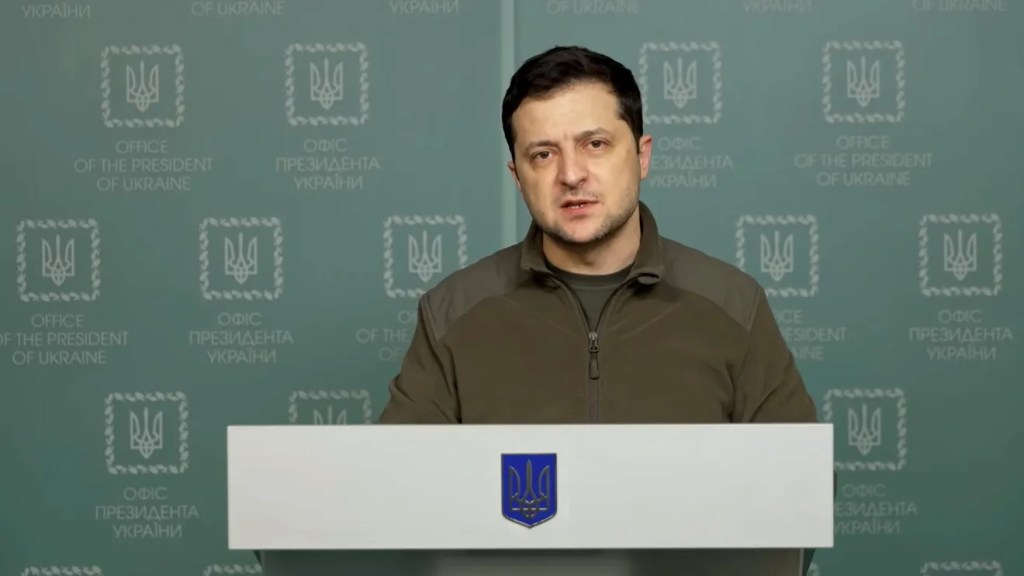
Finally, the Ukrainian people have proved themselves of indomitable spirit. The general attitude is encapsulated by an audio recording, in which an outpost of thirteen Ukrainians on Zmiinyi Island calmly instructs a Russian warship to “go fuck [it]self”. There is resilience, pride, and, amazingly, humour. Perhaps that mix makes sense, given President Zelenskyy’s former life as a comedian. The Ukrainian premier has shown himself to be a leader in the truest sense of the word, remaining in Kyiv even as Russian ground troops close in. He’s released a stream of videos from secret locations in the city, bags visible beneath his eyes, praising his citizens’ bravery, describing calls with other world leaders, and striking a note of patriotic defiance. Pretty much every newspaper in the West has run an article on the man, usually with an unfavourable comparison to our own heads of state.
I don’t think it’s an exaggeration to say that Putin has bitten off more than he can chew.
It is at this point, though, that we must ask some difficult questions. Why does the West suddenly care so much about Ukrainian sovereignty, Ukrainian refugees? Where is the outcry over wounded children in Palestine? Over hunted individuals in Afghanistan? Over innocent, beleaguered families in Syria and Yemen? The answer, however distasteful, can only be that this invasion is closer to home, on European soil, and predominantly affects white people. Geographical and cultural proximity make the violence more real. It’s disappointing that our collective psyche works this way. Alas, that is human nature.
But whilst we must acknowledge a hypocrisy in our sudden fixation on Ukraine, this hypocrisy doesn’t make the West’s actions wrong. Anything that helps displaced civilians, and supports a democratically elected government against an invading state, must by definition be a moral good.
Russia, of course, is more than just a “state”. It has significant geopolitical influence, through its permanent seat on the UN Security Council, its deep ties with former-Soviet states, and its oil and natural gas exports to Europe.
This last point is important. Further sanctions from the EU and G7 countries are highly likely to target Russia’s oil exports, forcing Russia to find alternative buyers. This will be punishing for Western consumers, who are already facing astronomical increases in energy bills. However, these developments may accelerate the West’s search for alternative power, whether that be green, hydrogen or nuclear. Such initiatives would help create new jobs, whilst reducing dependency on foreign exports for our energy.
Russia’s other major advantage is its nuclear capability. It has the world’s largest arsenal of nuclear weapons, at approximately 6,000 warheads. A direct confrontation between NATO and Russia would be a world-ending event. Both forces might play at conventional warfare for a while, but if defeat ever looked inevitable, they would have a literal nuclear option. Putin knows this, the West knows this, and it is the Ukrainian people who will suffer for it.
So, what next? As each day passes, more civilians are blown up or maimed, more history is lost, and more ground is ceded to the new iron curtain. We must step up economic sanctions, applying as much external pressure as possible to Putin’s inner circle, encouraging them to speak truth to madness. We need to deploy our offensive cyber capabilities, hampering the Russian networks (whether domestic or military) wherever possible. And most importantly, we must continue to offer sanctuary to those who have fled. Let the eye of history see warmth and welcome in the west, against a backdrop of blitz and bloodshed to the east.
On an individual basis, anyone looking to contribute finances to humanitarian or military efforts in Ukraine can follow the links below:
https://donate.redcross.org.uk/appeal/ukraine-crisis-appeal
(Supplies basic essentials to civilians caught in the Ukraine crisis)
(A special account set up by the Ukraine Central Bank to receive funds for the country’s armed forces)

 Shorter Poems