Gretchen Ross traipses through the empty halls of her new school. Class has already started, and now she’s going to embarrass herself by interrupting. She pulls her textbooks more tightly to her chest. Here it is: room 28. She enters without knocking. The hinge creaks like an arthritic wardrobe. She may as well have announced her arrival with a trumpet.
Sixteen heads swivel round to gawk at the newcomer. Slouched against a desk at the front, facing Gretchen, is Drew Barrymore.
“May we help you?” she enquires.
“Yeah — I just registered, and they put me in the wrong English class.”
“You look like you belong here.”
Gretchen isn’t quite sure what to make of this comment. “Um. Where do I sit?”
Drew Barrymore considers for a moment, her mouth turned downwards in mischievous contemplation. “Sit next to the boy you think is the cutest.”
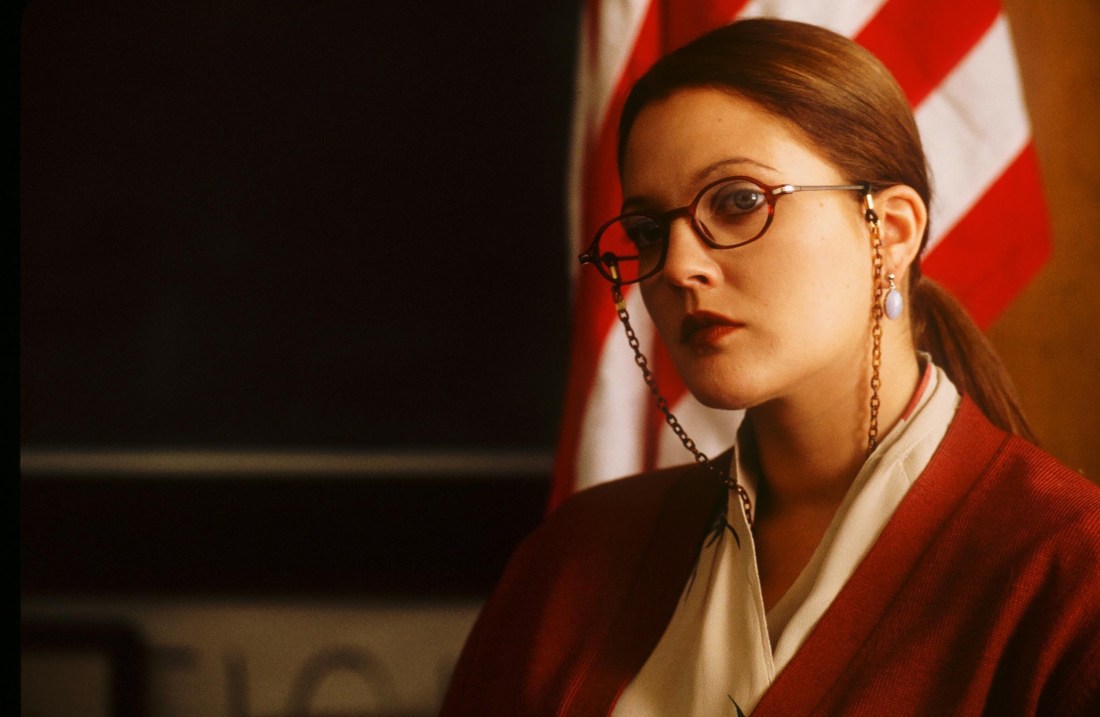
It was at this moment, whilst watching (almost two decades late) Richard Kelly’s cult classic, Donnie Darko, that I began to feel like I was viewing the most realistic representation of a dream ever recorded. Drew Barrymore’s suggestion is so deliciously prurient, so un-teacherly, that in the mouth of a bad actor it might sound forced or clunky. But Barrymore carries the line, establishing herself as something of a free-spirit within an otherwise crusty institution. I never once questioned the propriety of her words. Nor did I question an obvious plot hole that crops up moments later: Barrymore allowing Gretchen to sit next to Donnie, whom she appears to have chosen as the “cutest”, by making another girl stand up. It’s never explained where this displaced student is moved too, as there don’t appear to be any free seats in the class. But all of that is besides the point. Just as in a dream, your focus is on an immediate, seemingly-logical narrative; one that, in the analytical light of morning, was clearly an illusion, riven with impossibilities.
Donnie Darko is chock-a-block with such vivid, oneiric moments. For instance, we’re soon introduced to Barrymore’s foil in the film, a vindictive, super-Christian teacher/parent named Kitty (think Angela from The Office). In one of the film’s best scenes, Kitty (wearing a “God is AWESOME” tee) calls on Donnie’s mother and, standing in her doorway, begs her to accompany the student dance troupe to Los Angeles the next morning, as she’s no longer able to take them herself. As Mrs. Darko demurs, Kitty becomes frantic. Eerie, wailing music creeps into the exchange — music that belongs in a confined space, as an overture to some terrifying revelation. And yet here it is, in the sun-dappled streets of Middlesex, Virginia. Kitty’s consternation mounts. With the cracked rasp of a penitent murderer admitting to their crime, she speaks the damning words, “Sometimes I doubt your commitment to Sparkle Motion!” (Understandably, this line has become a fan favourite; you’ll find it oft repeated in the comments section of any Darko-related material online). Mrs. Darko’s response is equally loaded. She doesn’t speak, she simply stares at Kitty with a tortured smile, as if to say, Have you ever stopped to listen to the bullshit you’re spouting?
Indeed, my main takeaway from Donnie Darko is its insistence on the need to cut through bullshit: to separate the false logic of dreams from tangible reality. To speak out against things that don’t make sense. We see this most clearly in Donnie’s “Life Skills” class, taught by none other than Kitty. In one segment, the class are made to watch a video on overcoming fear, presented by local life coach Jim Cunningham (Patrick Swayze). Richard Kelly deftly condenses every awful, cringeworthy educational video of your youth into an absurdly saccharine two minutes. With clichéd spiritual rock riffing in the background, a woman stares down at her son, lamenting, “For two years, I thought it was normal for a ten-year-old to wet the bed.” This elicits a single, quickly-hushed snigger, but most of the class watch without expression. They’ve become so accustomed to this moronic, feel-good propaganda, that they can’t even find it funny. We then get a portrait shot of the bed-wetter, who exclaims, fiercely, “I’m not afraid anymore!”

The video serves to foreshadow Donnie’s stand in a later lesson. He refuses to accept Cunningham’s philosophy (espoused by Kitty) that all human action can be divided into two emotional causes: fear and love. He challenges Kitty’s restrictive thinking, arguing on behalf of “the whole spectrum of human emotion”. Yet in the twisted dream-logic of Donnie’s world, his reliance on common sense is not met with any kind of rational debate. Instead, Kitty threatens him with a zero in his assignment. Encapsulated in this exchange is the idea that life — especially an institutionalised life — can sometimes feel more like a dream than reality. The rigorous prescriptivism of exam-centric schooling ensures that students are ushered along from one year to the next, never challenging what they are taught, never deviating from the syllabus. In this way, the film implies, school is made of the stuff of dreams: bullshit.
I realise now that I’ve said quite a lot about Donnie Darko, without even mentioning its more obviously surreal elements. For instance, early on we’re introduced to a prophetic, man-sized rabbit named Frank. Soon after, Donnie starts to observe temporal portals sprouting from people’s sternums. The issue is that Donnie’s perspective is less than reliable. He’s taking medication for schizophrenia, and is a self-confessed “whacko”. People have spent an awful lot of time and energy theorising on these aspects of the film. How real they are, what they mean, why exactly Donnie has to follow Frank’s orders to prevent an impending apocalypse. To my mind, though, these more fantastical aspects of the film are equivalent to a dream’s underlying emergency. Take, for example, the common dream-emergency of being late for an exam — one that I experienced a few times before Finals. I don’t recall ever actually making it to Exam Schools to face the consequences of my tardiness. Instead, I’d find myself waylaid by random figures from my life, people who had no business being on the Oxford High Street at 9.30am. If I’d simply stopped to consider the implausibility of their presence, the dream-logic would have crumbled. Similarly, the closer Donnie draws to Frank and the film’s mysticism, the more “reality” starts to unwind. When Frank convinces him to burn down Cunningham’s home, the celebrated life coach is exposed as a paedophile; as Donnie prepares to confront Grandma Death, Gretchen reveals her mother had been abducted. The accepted truths of Donnie’s world — our world — seem increasingly ephemeral. The best in society are fraudsters, and nobody is ever truly safe. It’s hardly surprising, then, that Donnie turns his back on this “reality”. He decides rather to go straight down the rabbit-hole, to avert the dream-emergency and awaken himself from a living sleep.



 Shorter Poems