I’ll start this piece with a disclaimer: I think Rupi Kaur is an awful poet. Her cutesy, axiomatic style is almost entirely lacking in the mystery, invention, and force of language that, for me at least, make a great poem. That she’s achieved such global fame (mainly through her Instagram presence) pays testament to our sorry habit of revering mediocrity, so long as it is easily digestible.
I’ve yet to meet anyone who will earnestly defend the quality of Kaur’s writing. However, I have heard two arguments in support of her work more generally. The first is that Kaur often acts as an introduction to poetry for young people. This argument characterises Kaur as a gateway poet, in the same way that a Good Christian Mum might characterise weed as the initial step towards a life of crack-fuelled hedonism. And, I’m sure, some people have gone on to read more challenging and creative material since discovering Kaur. Yet I worry that the simplicity of Kaur’s work, its unabashed lack of intrigue, makes people less receptive to such complexity in other poems. For someone on Instagram, it’s far more likely that their following of Kaur will lead them to discover accounts like Atticus, whose on-the-nose sententiousness makes Kaur’s poetry look like an enigma code.
The other argument, which, in my opinion, carries more weight, is that Rupi Kaur is not so much about the medium as the message. That most people who follow her know very well that they aren’t reading innovative verse, but support her central ideas of feminist empowerment. And I can absolutely get behind that. Indeed, I imagine Kaur herself is well aware that it is her message, rather than her art, that does the numbers (I mentioned at the start that I think Kaur is an awful poet; I also think that’s she’s an astute entrepreneur).
However, Kaur’s reliance on a fundamental idea, as opposed to good writing, comes with its own drawbacks. As an example, we need only look at her most recently uploaded poem:

The first thing I noticed about this poem was its form: a single block of text. For Rupi “hit-the-enter-key-at-irregular-intervals” Kaur, this is practically radical experimentalism. But the next glaring aspect of this piece is its rather ugly tone. Kaur predicts that the addressee’s next girlfriend “will be a bootleg version of who i am.” (Side note: Kaur appears to have an inexplicable aversion to capital letters). We might wonder why Kaur, who’s brand is built around supporting women, inspiring women, and articulating women’s issues, has decided to go after a woman who she’s never even met. Worse, she then goes on to discredit this future woman’s poetic and sexual proficiencies: she won’t “lick, caress, or suck” like Kaur, and her poems certainly won’t be delivering any jabs to the gut — she’ll only “try to make love to your body” (spoken to the rhythm of Shape of You by Ed Sheeran).
The main thrust of the poem is clear: Kaur is engaging in a common post-break-up fantasy, imagining her former lover’s dissatisfaction with his new flame. The “bootleg woman”, caught between Kaur and the target of her angst, is ground into inferiority by Kaur’s exultant vision of a pining ex-boyfriend.
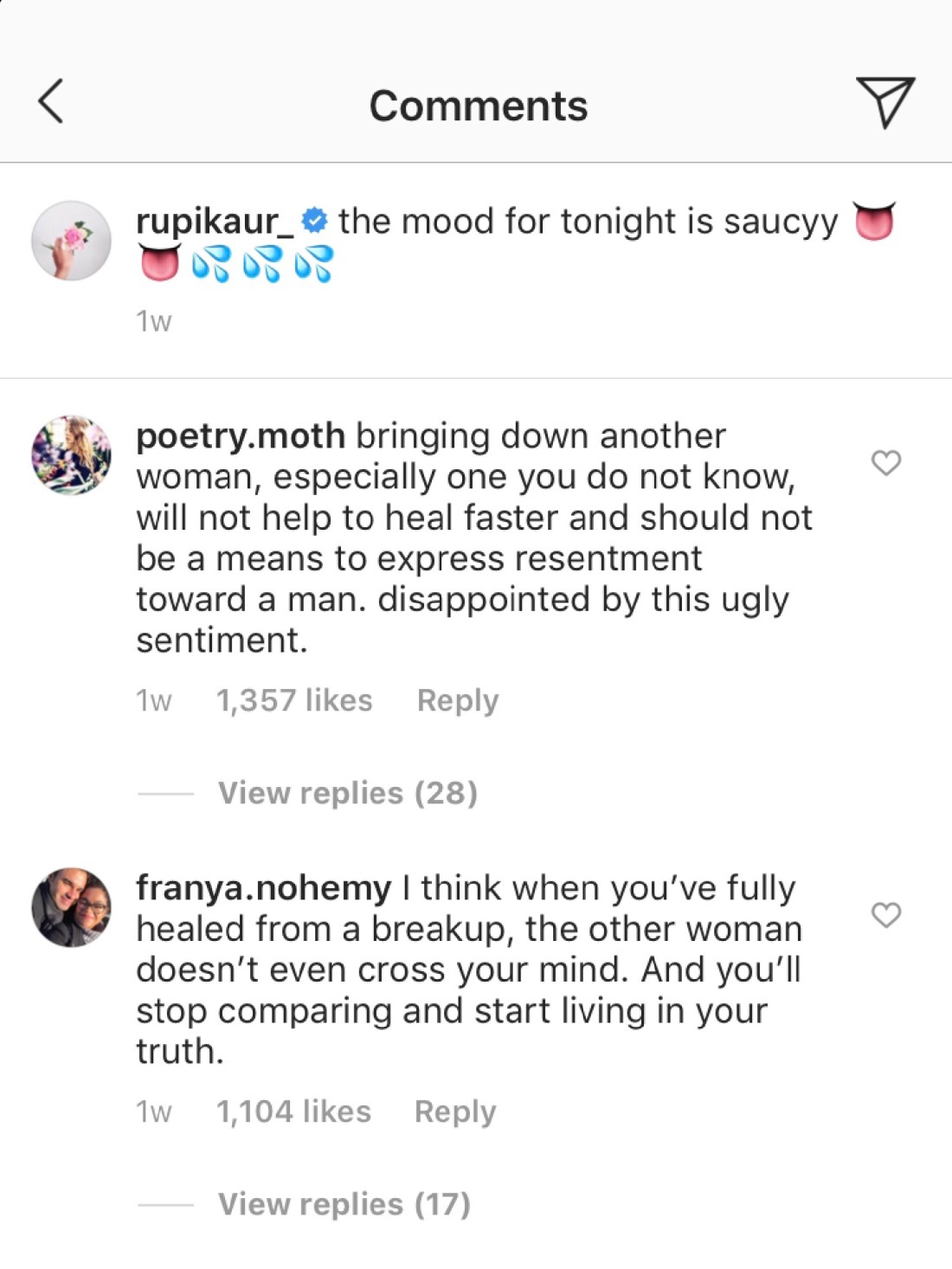
Significantly, Kaur might have cleared all of this up with a simple addendum. She might, for instance, have mentioned that this poem is a representation of internalised misogyny. She might have mentioned that the behaviour of men in relationships can create feelings of conflict amongst women (and that often, these feelings are misdirected). Instead, all we get is the caption: the mood for tonight is saucyy, along with a few emojis that, to be fair, neatly illustrate the line “lick, caress, or suck like me”. (Another side note: I shudder every time I write that out). These words make it clear that Kaur doesn’t recognise the troubling suggestion expressed in the poem. Namely, that being a woman on top sometimes involves putting other women down .
Maybe I’m being too harsh. Maybe I need to remember the first rule of poetry analysis, and separate Kaur from the speaker of the poem. Ordinarily, I’d agree. But in this instance, I find it almost impossible. You see, Kaur spends a lot of time making her poems as generic — and therefore as relatable — as possible. She’ll often crank out a variation of the following:
my body is a [natural phenomenon]
you may try to [something to do with curbing nature]
but I will [something to do with escaping confines].
These poems achieve mass-appeal because there is so little of Kaur in them. They can be taken up by readers, and applied to their lives. They’re similar to pop songs, in that their catchiness lies in their lack of specificity. Yet Kaur’s most recent offering is different. In particular, the mention of poems that have been “left memorized” on the ex-boyfriend’s lips make it abundantly clear that Kaur is versifying here as herself.
Moreover, the clichéd mundanity of the poem, the absence of arresting imagery, ambiguous phrasing or novel tone, ensure that there is scant material to hold on to other than the central idea. Kaur’s business model, of maxim-like poetry designed to impart a simple message during a quick scroll, makes it difficult to read these more specific poems as anything other than her own direct thoughts. Consequently, when Kaur diverts from her usual ideas, of obvious feminist-empowerment or twee reflections on the sun/moon/flowers/butterflies/et cetera, people don’t criticise the quality of the poem, but rather the quality of the message (although about 90% just type yaaaas kweeen 💅🏼, probably without reading a word):
I suppose then that Kaur has created her own poetic prison. Having established herself as the voice of feminist poetry on Instagram, and having built an enormous following through deliberately generic verse, her attempts to move towards more personal or specific ideas are likely to meet backlash. She doesn’t have aesthetic creativity to fall back on. All she has is a central idea. And reliance on a single idea encourages stagnation — the death of poetry.


 Shorter Poems